In the terminal building of the Sudbury Airport, my father sits hunched over a telephone on a small desk. With the handset cradled in his shoulder and a pencil poised over a scrap of paper, he listens to the dial tone. A yellowed thumbnail grinds away at the splintering edge of the desk. Eyes flit nervously from the blank paper to the windows overlooking a quiet tarmac and the unsettled soupy haze of an unhappy sky.
A few mumbled words, a pause, and then the right hand begins to work furiously - scratching what, to the inexperienced eye, is gibberish...a mess of letters, numbers and symbols. The paper begins to rumple as it is caught between the pencil's tip and the writer's dragging palm.
All the while, the thumb continues its meaningless mission.
A mumbled thanks, the handset is replaced, notes are consulted and crammed into the pocket of a pair of dirty jeans.
Outside, a blue and white Piper Warrior waits quietly.
Ugly, swirling clouds begin to peek over the western horizon.
"Don't do it," the voice shatters the silence hanging thick in the terminal building. Mid-stride, dad stops, and looks over his shoulder at a man Ernest Gann would have described as "an old pelican." He's sitting in a vinyl chair; twinkling eyes and unruly eyebrows working over the lip of a tattered newspaper.
"It isn't worth going," he reiterates.
"I'll have a look," my dad replies...but the uncertainty and doubt is swelling in the pit of his stomach. He makes for the door.
"Suit yourself," the old pelican replies softly. Eyes and eyebrows disappear behind newsprint once again.
15 minutes later, dad is cocooned in the lonely sanctuary of C-GGDI's cockpit. Having just climbed out of Sudbury, he's taken a heading roughly south. It'll be 50 miles or so before he hits the northern shore of Georgian Bay then another 80 miles over the water to Wiarton. He's considered taking the long way around by skirting the eastern shore of the bay but the weather would be on top of him by then...and his tiny craft wouldn't stand a chance. He left Collingwood for Kapuskasing the afternoon before - stopping to drop off men and gear in Sudbury and Timmins - nearly 4 hours in the air. Today, another 2 hour run from Kapuskasing to Timmins and then Sudbury. Now, Wiarton beckons from across the bay.
Under the wings, the harsh coniferous wilderness of northern Ontario is broken by whitecaps whipped wild by the whirling wind. Georgian Bay stretches out beyond the nose and crystalline arc of the propeller. On either side, clouds billow and broil...building into ugly, cancerous masses choking the horizon.
Rain begins to speckle the windshield. The wind picks up. The whitecaps below get whiter.
Fear in an airplane is a lonely and unforgiving thing. It is cold. You shiver and sweat all at once. The numbing drone of the engine is no longer a comfort...but rather a constant reminder of your isolation and insignificance. Every decision made up until this point becomes both monumental and meaningless. One makes any number of deals and bargains, swears allegiance or fealty to any number of lords...good or otherwise. Fear whispers in your ear, breathes on the back of your neck, promises salvation in exchange for surrender. It is quiet. And desperate. And sickening.
The horizon melts away. Everything is a uniformly damp blue. There is no up, nor down. He may be in cloud, he may not. It doesn't matter. It becomes painfully evident that the bottom is falling out.
Less than 300 hours are set down in his logbook. Another 5, perhaps 10 miles on this unwise course and he'll become the textbook example of a statistic.
My dad lowers his eyes and looks hard at the instruments. His shoulders draw inward as if to steel himself against the onslaught of Fear and Fate. I'm sure he heard Murray Sinton's voice, or Alan Coulson's, Biff Hamilton's...perhaps the more recent Ken Richardson's.
"I was scared," he told me 30 years later. "Really scared. I should have listened to the old man and never tried it."
"What did you do?"
"What I'd been taught," he answered. "Make a 180 degree, rate-one turn and get the hell out of there."
30 awful minutes later, GDI touches down at Sudbury airport with an unsettled bounce. My dad walks through the rain, slowly...as if to wash away Fear's shroud.
Inside the terminal, the old pelican hasn't moved. The newspaper is lowered and the crow's feet reaching out from the corners of his twinkling eyes crease and spread.
"Good to see you again, young fella," he says with an unseen smile.
"Welcome back."
Showing posts with label Murray Sinton. Show all posts
Showing posts with label Murray Sinton. Show all posts
Monday, 27 August 2012

Wednesday, 15 August 2012
Ghosts
Facebook is often a dumping ground of mindless blather and rubbish. It is expanding at a rate that rivals urban sprawl. However, it can also be a tool - quite a remarkable one - shrinking the globe and revealing hidden treasures, stories and memories lost for decades.
So, in July of 2012, I sounded the depths of Mark Zuckerberg's creation for Murray Sinton. I'll admit I took a ridiculously remote shot in the dark, I told this "Murray Sinton" as much, but I couldn't shake the feeling that I was on to something.
Then, about a month later, in the dead of night, my blackberry clanged enthusiastically. It rose me from my slumber and as my myopic eyes swam in the murk to find my glowing watch face, I considered rolling over to pluck my phone from the carpeted bedroom floor.
3:24 in the morning. I'm getting up in less than 90 minutes. Forget it.
Six minutes later - another ping shattered the silence.
I felt for my glasses, pushed them on and groped for the phone lying face-down on the carpet and ringed in white light.
When I saw the name staring back at me, my body temperature jumped a few degrees.
It turns out that my absurdly long shot, lobbed through social media clear around the world, was right on target.
Murray Sinton is alive and well, and after a long aviation career, is enjoying his retirement in Perth, Australia.
Over the last few weeks, we've been swapping emails back and forth. I thought I would share one with you.
I must say I am honoured to be held in such high esteem by your late father (sorry to hear of his passing). It was something I always believed in trying to impart throughout my instructing over 30 odd years.
I read the blog from start to finish & found the history of all the air crafts I used to instruct on back when your father was learning very interesting. Sadly most of them, like your father, are no longer with us but live on in our memories.
From what I can remember your dad was a very keen & willing student who completed all his tasks diligently & enthusiastically & had that natural ability of coordination & judgement needed to fly.
If I remember correctly he was one of my first batch of pupils assigned to me by the flying school as a brand new assistant instructor. However, we got on very well throughout his quest to get his PPL which he passed on the first attempt.
Unfortunately, I do not have any photos but of course the early days of my flying career were at Wilken Flying School. The weather in Kenya being very kind to private flying as there were very few days that it kept one grounded.
Of course all of this was over 40 years ago now & I lost count of the number of students I taught since those first ones.
I, in fact, left the flying school after two years with them to further my career & spent a few years flying for a charter company before leaving Kenya for South Africa where I opted for the Corporate environment & ended up my flying days flying the Canadair Challenger series of air crafts.
This took me all over the globe & of course regular visits to Montreal for refresher simulator courses.
I am now happily retired in Perth Australia with all of my family close by.
I have regular contact with a number of those I taught way back then as most of them went on to become airline skippers & so migrated to all corners of the world.
As for the other instructors at Wilken, Mike Amos passed away a few years ago, Paul Lennox was killed in an aircraft bomb explosion on his way back to Nairobi from a visit to the infamous Idi Amin in Uganda. Alan Coulson I am not sure about but heard rumours of his demise. Clive Corner is alive & well & living in UK where he has retired.
I do still have the silver eagle tucked away with other flying memorabilia & had forgotten it was from your dad, thanks for the memory jog.
Do continue to complete this project but I don't know if I can be of any more help but would love to read its conclusion.
Keep up the good work in passing on your knowledge to your students & above all enjoy your flying days to the full.
Regards
Murray
Two things happened as I read Murray's recollections.
I grew up wanting to be a pilot - like my dad - and so, when it came to aviation, he was a giant. The fact that he learned to fly in Africa - in clear, pristine skies over the wild Savannah - only reinforced this feeling. Murray's story, however brief, helped me realize my dad and I had been in the same place, albeit separated by more than 30 years and half a globe. It unearthed a kinship I always knew existed but never fully understood.
And until Murray's note, Amos, Corner, Coulson and Lennox were just names written on the yellowing pages of an old logbook. Now, they had first names, and lives, loved ones, histories, triumphs, and tragedies...heartbeats.
One such heartbeat, that of Paul Lennox, was stopped with such cruelty and senselessness.
On June 27th, 1976, Air France Flight 139 from Tel-Aviv to Paris was hijacked by operatives of the Popular Front for the Liberation of Palestine as well as members of the German Revolutionary Cells. The aircraft was eventually flown to Entebbe Airport near the Ugandan capital of Kampala where the hijackers were supported by the pro-Palestinian forces of President Idi Amin. The hijackers released most of the 260 passengers but kept 106 people - mainly Israelis - captive.
One week later, Israeli Defense Forces (IDF) troops staged a brazen raid. Under the cover of darkness, they landed a force of 100 soldiers at Entebbe Airport and stormed the terminal building where the hijackers were holding their hostages. The commandos killed the hijackers and as many as 45 Ugandan soldiers. Three hostages who were caught in the crossfire also died. The assault force's commander, 30-year-old Lt. Colonel Yonatan Netanyahu (oldest brother of the eventual Israeli Prime Minister) was killed. 103 hostages were saved. Idi Amin was humiliated.
The IDF wedged months of planning into mere hours. The success of the mission hinged on gaining safe passage through the airspace of neighbouring African nations. To do so without permission was considered an act of war. Kenya not only agreed to allow the IDF forces to fly through their airspace but offered Nairobi's international airport as a refueling stop.
Kenya - led by President Jomo Kenyatta - was sympathetic to the plight of the hostages. Jomo Kenyatta's Minister of Agriculture at the time was a man named Bruce MacKenzie. He was a former RAF pilot with deep connections to British Intelligence. He secured right of passage for the Israeli operation.
Idi Amin, it seems, did not forget this.
Two years later, MacKenzie left his ministerial post for business which took him to Uganda and other countries. He was selling radio technology for Wilken Telecommunications - part of the group that owned Wilken Aviation and its flying school. One of his clients was the Ugandan Army - and Idi Amin. He made frequent trips to visit the African dictator.
May 24th 1978 was one such day. MacKenzie and two fellow businessmen - Keith Savage and Gavin Whitelaw - made a trip from Wilson Airport in Nairobi to Entebbe in a Wilken-owned twin engine Piper Aztec registered 5Y-ACS. Paul Lennox was the pilot.
In Kampala, they met with Amin. When the business of the day was concluded, Amin saw them off at the airport. As Lennox fired up the engines at 4:19 in the afternoon, an Amin aide rushed to the side of the plane with a parcel.
He explained it was a lion's head carved from a block of wood - a gift from Amin to MacKenzie. The former Minister tried to turn it down but the aide insisted. MacKenzie relented, accepted the package, slammed the door shut and Lennox taxied for departure.
Inside the guts of the parcel, deep within the lion's head, beat a heart of explosives and a timer...ticking away the seconds each man had to live.
At 5:58 that evening, the Aztec was nearing Nairobi. Lennox keyed his microphone.
"Escarpment position, 20 miles from Wilson," the pilot reported.
Minutes later, Maasai herdsman heard a loud pop and turned their eyes upwards. Pieces of the Aztec were twirling lazily to earth in flames - like falling leaves glinting in the African sun. The four men were dead.
Idi Amin was immediately implicated. He denied the allegations and called MacKenzie one of his best friends. When Amin tumbled from power in 1979, his "special advisor", 56-year-old British born Bob Astles, was detained in Kenya - suspected as the perpetrator of the bombing and sent to Uganda to face charges. He was acquitted but served 6 and a half years in Luzira Prison. In 1985, he was released and returned to Britain where he lives now. He continues to deny the allegations.
The whispers of Idi Amin's involvement - and that of his associates - persist.
Paul Lennox, the man who signed off on my dad's first solo, just showed up for work that May day in 1978 - to do something he loved.
He paid with his life.
So, in July of 2012, I sounded the depths of Mark Zuckerberg's creation for Murray Sinton. I'll admit I took a ridiculously remote shot in the dark, I told this "Murray Sinton" as much, but I couldn't shake the feeling that I was on to something.
Then, about a month later, in the dead of night, my blackberry clanged enthusiastically. It rose me from my slumber and as my myopic eyes swam in the murk to find my glowing watch face, I considered rolling over to pluck my phone from the carpeted bedroom floor.
3:24 in the morning. I'm getting up in less than 90 minutes. Forget it.
Six minutes later - another ping shattered the silence.
I felt for my glasses, pushed them on and groped for the phone lying face-down on the carpet and ringed in white light.
When I saw the name staring back at me, my body temperature jumped a few degrees.
It turns out that my absurdly long shot, lobbed through social media clear around the world, was right on target.
Murray Sinton is alive and well, and after a long aviation career, is enjoying his retirement in Perth, Australia.
Over the last few weeks, we've been swapping emails back and forth. I thought I would share one with you.
I must say I am honoured to be held in such high esteem by your late father (sorry to hear of his passing). It was something I always believed in trying to impart throughout my instructing over 30 odd years.
I read the blog from start to finish & found the history of all the air crafts I used to instruct on back when your father was learning very interesting. Sadly most of them, like your father, are no longer with us but live on in our memories.
From what I can remember your dad was a very keen & willing student who completed all his tasks diligently & enthusiastically & had that natural ability of coordination & judgement needed to fly.
If I remember correctly he was one of my first batch of pupils assigned to me by the flying school as a brand new assistant instructor. However, we got on very well throughout his quest to get his PPL which he passed on the first attempt.
Unfortunately, I do not have any photos but of course the early days of my flying career were at Wilken Flying School. The weather in Kenya being very kind to private flying as there were very few days that it kept one grounded.
Of course all of this was over 40 years ago now & I lost count of the number of students I taught since those first ones.
I, in fact, left the flying school after two years with them to further my career & spent a few years flying for a charter company before leaving Kenya for South Africa where I opted for the Corporate environment & ended up my flying days flying the Canadair Challenger series of air crafts.
This took me all over the globe & of course regular visits to Montreal for refresher simulator courses.
I am now happily retired in Perth Australia with all of my family close by.
I have regular contact with a number of those I taught way back then as most of them went on to become airline skippers & so migrated to all corners of the world.
As for the other instructors at Wilken, Mike Amos passed away a few years ago, Paul Lennox was killed in an aircraft bomb explosion on his way back to Nairobi from a visit to the infamous Idi Amin in Uganda. Alan Coulson I am not sure about but heard rumours of his demise. Clive Corner is alive & well & living in UK where he has retired.
I do still have the silver eagle tucked away with other flying memorabilia & had forgotten it was from your dad, thanks for the memory jog.
Do continue to complete this project but I don't know if I can be of any more help but would love to read its conclusion.
Keep up the good work in passing on your knowledge to your students & above all enjoy your flying days to the full.
Regards
Murray
Two things happened as I read Murray's recollections.
I grew up wanting to be a pilot - like my dad - and so, when it came to aviation, he was a giant. The fact that he learned to fly in Africa - in clear, pristine skies over the wild Savannah - only reinforced this feeling. Murray's story, however brief, helped me realize my dad and I had been in the same place, albeit separated by more than 30 years and half a globe. It unearthed a kinship I always knew existed but never fully understood.
And until Murray's note, Amos, Corner, Coulson and Lennox were just names written on the yellowing pages of an old logbook. Now, they had first names, and lives, loved ones, histories, triumphs, and tragedies...heartbeats.
One such heartbeat, that of Paul Lennox, was stopped with such cruelty and senselessness.
On June 27th, 1976, Air France Flight 139 from Tel-Aviv to Paris was hijacked by operatives of the Popular Front for the Liberation of Palestine as well as members of the German Revolutionary Cells. The aircraft was eventually flown to Entebbe Airport near the Ugandan capital of Kampala where the hijackers were supported by the pro-Palestinian forces of President Idi Amin. The hijackers released most of the 260 passengers but kept 106 people - mainly Israelis - captive.
One week later, Israeli Defense Forces (IDF) troops staged a brazen raid. Under the cover of darkness, they landed a force of 100 soldiers at Entebbe Airport and stormed the terminal building where the hijackers were holding their hostages. The commandos killed the hijackers and as many as 45 Ugandan soldiers. Three hostages who were caught in the crossfire also died. The assault force's commander, 30-year-old Lt. Colonel Yonatan Netanyahu (oldest brother of the eventual Israeli Prime Minister) was killed. 103 hostages were saved. Idi Amin was humiliated.
The IDF wedged months of planning into mere hours. The success of the mission hinged on gaining safe passage through the airspace of neighbouring African nations. To do so without permission was considered an act of war. Kenya not only agreed to allow the IDF forces to fly through their airspace but offered Nairobi's international airport as a refueling stop.
 |
| Bruce MacKenzie - Kenyan Minister for Agriculture, former RAF pilot, British Intelligence Operative, businessman, victim of a terrorist bombing. He was 58 when he died. |
Kenya - led by President Jomo Kenyatta - was sympathetic to the plight of the hostages. Jomo Kenyatta's Minister of Agriculture at the time was a man named Bruce MacKenzie. He was a former RAF pilot with deep connections to British Intelligence. He secured right of passage for the Israeli operation.
Idi Amin, it seems, did not forget this.
Two years later, MacKenzie left his ministerial post for business which took him to Uganda and other countries. He was selling radio technology for Wilken Telecommunications - part of the group that owned Wilken Aviation and its flying school. One of his clients was the Ugandan Army - and Idi Amin. He made frequent trips to visit the African dictator.
May 24th 1978 was one such day. MacKenzie and two fellow businessmen - Keith Savage and Gavin Whitelaw - made a trip from Wilson Airport in Nairobi to Entebbe in a Wilken-owned twin engine Piper Aztec registered 5Y-ACS. Paul Lennox was the pilot.
In Kampala, they met with Amin. When the business of the day was concluded, Amin saw them off at the airport. As Lennox fired up the engines at 4:19 in the afternoon, an Amin aide rushed to the side of the plane with a parcel.
He explained it was a lion's head carved from a block of wood - a gift from Amin to MacKenzie. The former Minister tried to turn it down but the aide insisted. MacKenzie relented, accepted the package, slammed the door shut and Lennox taxied for departure.
Inside the guts of the parcel, deep within the lion's head, beat a heart of explosives and a timer...ticking away the seconds each man had to live.
At 5:58 that evening, the Aztec was nearing Nairobi. Lennox keyed his microphone.
"Escarpment position, 20 miles from Wilson," the pilot reported.
Minutes later, Maasai herdsman heard a loud pop and turned their eyes upwards. Pieces of the Aztec were twirling lazily to earth in flames - like falling leaves glinting in the African sun. The four men were dead.
Idi Amin was immediately implicated. He denied the allegations and called MacKenzie one of his best friends. When Amin tumbled from power in 1979, his "special advisor", 56-year-old British born Bob Astles, was detained in Kenya - suspected as the perpetrator of the bombing and sent to Uganda to face charges. He was acquitted but served 6 and a half years in Luzira Prison. In 1985, he was released and returned to Britain where he lives now. He continues to deny the allegations.
The whispers of Idi Amin's involvement - and that of his associates - persist.
Paul Lennox, the man who signed off on my dad's first solo, just showed up for work that May day in 1978 - to do something he loved.
He paid with his life.
Wednesday, 4 July 2012
Confessions
March 19th, 2012 - about 5 miles north-east of Gatineau.
I'm sitting in the back of a newish Super Decathlon, slowing down through 90 knots.
Then, a deep breath.
Stick full back, a swift push of my left foot against the rudder pedal and the horizon vanishes under the nose.
A shudder, the left wing drops sharply - a little aileron now to help the roll but we're rotating quickly as it is.
The horizon now dissecting my limited view forward, now revolving madly, now over my head...
Stick forward now, full opposite rudder and some measure of normalcy returns with straight and level flight.
A snap roll in the Super Decathlon takes roughly two seconds. It is the fastest roll the airplane will do.
My student, riding up front, is impressed.
"Awesome!" he shrieks. He's a grown man - married with two kids. I love his enthusiasm. "Do another?"
I oblige.
"Again!" Les gets younger with every manoeuvre.
I shrug. We whip around a third time.
"Okay, I'm done," says Les from the front seat. I turn over control of the aircraft and I hear him talking to the terminal controller as we start a sweeping right turn for home.
I'm gazing forlornly at the Gatineau Airport crawling by under our wings.
I wish I could tell my dad about the snap rolls. He'd want to hear about it.
My father and I enjoyed a good relationship although it was one that grew difficult as we aged.
We certainly shared the passion of flying and a voracious appetite for literature - but little else.
In fact, in the last few years, we only ever spoke of flying, reading, hockey and work. More often than not, we clashed - and that thanks to radically different personalities. One of his favourite things to say to me was "you sound/talk/act/think/behave like your mother." It was and still is true.
My sister inherited many more traits from my father than I did and he apparently always believed she would become the pilot and not I. Ironically and in a cruel twist, those very same traits assured she would never take to the skies as he did. In fact, my sister had very little interest in aviation. I spent most of my childhood sitting in airplanes. Vanessa spent the bulk of hers standing next to them striking a pretty pose.
My dad was a gentle and beautiful soul that suffered from bad timing and unfortunate luck. A series of personal catastrophes changed him over time. He withdrew into his work - it kept him anywhere but at home - and became more of an obsession than an occupation.
I had the happy fortune of spending many summers with my dad working on construction sites from North Bay to Niagara Falls. We would work Monday to Saturday and, after I received my pilot's license, find an airport to fly out of on Sundays. Aviation was, without a doubt, our strongest bond...and the one we spoke about the most.
FAM, however, was a ghost - talked about rarely yet fondly and existing in the pristine and endless skies of my father's memory. After he sold the plane, he had no interest in knowing where it was or what it was doing or who had the fortune of flying it. He cared only for where it had been, what it had been like to fly it and how it made him feel.
As he deteriorated, the old flying stories remained sharp albeit repetitive. At the time, hearing him prattle on about Murray Sinton and Alan Coulson, Biff Hamilton and Ken Richardson, the RF-5 and how the Chipmunk spun could be mildly irritating - only in that I'd heard the stories a million times before.
Now, I'd give anything to hear one again.
And perhaps that is why I'm so bent on seeing this project through...so haunted by the spectre of a red biplane and its one-time pilot.
Obviously, I can no longer consult my chief source on the matter. Finding and speaking to those who knew the aircraft intimately is a quest in history and archaeology. Snapshots and snippets of the story rise from the pages of logbook entries set down decades ago or from hastily scribbled notes on scraps of yellowing paper. Internet searches reveal little more than phone numbers that, if still connected, sometime lead to new information, new voices and old memories relived. One avenue uncovered inevitably leads to several more which branch out like the strands of a spider's web...and one can find themselves easily entangled in it. Chronology, as you can well imagine, becomes entirely useless and hopelessly ineffective. And so, the story takes on an organic feel...one that changes and evolves with each new scrap of information that comes to light.
There's a squeak, a shimmy and then I feel the weight transfer from my backside to my thighs. I'm prodded back to reality by the trundling of rubber on runway.
Les has the aircraft rolling on the main wheels down Runway 09 at Rockcliffe. The wind is not severe enough to make the wheel landing necessary but Les likes to practice...and I'm happiest when I can see where we're going. As we taxi off the runway at the end, we make two left turns and proceed down the taxiway towards the fuel pumps. We roll slowly, tail down, past an empty tie down; the familiar plot of land where the Mini-plane resided 25 years ago.
I gaze at the grass swaying ever so delicately in the early evening breeze.
I swear I hear the biplane's engine humming in the wind's breath.
I'm sitting in the back of a newish Super Decathlon, slowing down through 90 knots.
Then, a deep breath.
Stick full back, a swift push of my left foot against the rudder pedal and the horizon vanishes under the nose.
A shudder, the left wing drops sharply - a little aileron now to help the roll but we're rotating quickly as it is.
The horizon now dissecting my limited view forward, now revolving madly, now over my head...
Stick forward now, full opposite rudder and some measure of normalcy returns with straight and level flight.
A snap roll in the Super Decathlon takes roughly two seconds. It is the fastest roll the airplane will do.
My student, riding up front, is impressed.
"Awesome!" he shrieks. He's a grown man - married with two kids. I love his enthusiasm. "Do another?"
I oblige.
"Again!" Les gets younger with every manoeuvre.
I shrug. We whip around a third time.
"Okay, I'm done," says Les from the front seat. I turn over control of the aircraft and I hear him talking to the terminal controller as we start a sweeping right turn for home.
I'm gazing forlornly at the Gatineau Airport crawling by under our wings.
I wish I could tell my dad about the snap rolls. He'd want to hear about it.
My father and I enjoyed a good relationship although it was one that grew difficult as we aged.
We certainly shared the passion of flying and a voracious appetite for literature - but little else.
In fact, in the last few years, we only ever spoke of flying, reading, hockey and work. More often than not, we clashed - and that thanks to radically different personalities. One of his favourite things to say to me was "you sound/talk/act/think/behave like your mother." It was and still is true.
 |
| Sitting in a Cessna 172 at Carp, I think. This would be 1988 or 1989. (Family Collection) |
My sister inherited many more traits from my father than I did and he apparently always believed she would become the pilot and not I. Ironically and in a cruel twist, those very same traits assured she would never take to the skies as he did. In fact, my sister had very little interest in aviation. I spent most of my childhood sitting in airplanes. Vanessa spent the bulk of hers standing next to them striking a pretty pose.
My dad was a gentle and beautiful soul that suffered from bad timing and unfortunate luck. A series of personal catastrophes changed him over time. He withdrew into his work - it kept him anywhere but at home - and became more of an obsession than an occupation.
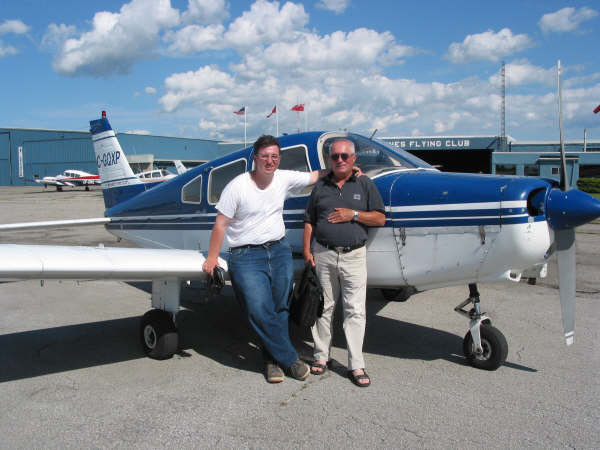 |
| Dad and I at the St. Catharines Airport in the summer of 2003 with PA-28-151 C-GQXP. This is right after the alternator regulator failed on take-off - my first in-flight "emergency." (Family Collection) |
I had the happy fortune of spending many summers with my dad working on construction sites from North Bay to Niagara Falls. We would work Monday to Saturday and, after I received my pilot's license, find an airport to fly out of on Sundays. Aviation was, without a doubt, our strongest bond...and the one we spoke about the most.
FAM, however, was a ghost - talked about rarely yet fondly and existing in the pristine and endless skies of my father's memory. After he sold the plane, he had no interest in knowing where it was or what it was doing or who had the fortune of flying it. He cared only for where it had been, what it had been like to fly it and how it made him feel.
As he deteriorated, the old flying stories remained sharp albeit repetitive. At the time, hearing him prattle on about Murray Sinton and Alan Coulson, Biff Hamilton and Ken Richardson, the RF-5 and how the Chipmunk spun could be mildly irritating - only in that I'd heard the stories a million times before.
Now, I'd give anything to hear one again.
And perhaps that is why I'm so bent on seeing this project through...so haunted by the spectre of a red biplane and its one-time pilot.
Obviously, I can no longer consult my chief source on the matter. Finding and speaking to those who knew the aircraft intimately is a quest in history and archaeology. Snapshots and snippets of the story rise from the pages of logbook entries set down decades ago or from hastily scribbled notes on scraps of yellowing paper. Internet searches reveal little more than phone numbers that, if still connected, sometime lead to new information, new voices and old memories relived. One avenue uncovered inevitably leads to several more which branch out like the strands of a spider's web...and one can find themselves easily entangled in it. Chronology, as you can well imagine, becomes entirely useless and hopelessly ineffective. And so, the story takes on an organic feel...one that changes and evolves with each new scrap of information that comes to light.
There's a squeak, a shimmy and then I feel the weight transfer from my backside to my thighs. I'm prodded back to reality by the trundling of rubber on runway.
Les has the aircraft rolling on the main wheels down Runway 09 at Rockcliffe. The wind is not severe enough to make the wheel landing necessary but Les likes to practice...and I'm happiest when I can see where we're going. As we taxi off the runway at the end, we make two left turns and proceed down the taxiway towards the fuel pumps. We roll slowly, tail down, past an empty tie down; the familiar plot of land where the Mini-plane resided 25 years ago.
I gaze at the grass swaying ever so delicately in the early evening breeze.
I swear I hear the biplane's engine humming in the wind's breath.
Thursday, 7 June 2012
Wings
My dad earned his wings on May 6th, 1971 after passing the private flight test on his first attempt.
He had used 9 pages of his logbook and logged 62 hours and 5 minutes of flight time - nearly 12 of which was solo.
A man named McAuliffe signed him off. His mount for the flight was 5Y-AJI - the same aircraft he took up solo for the first time.
His private flight training was done exclusively on Wilken's fleet of Piper Cherokee 140s.
The men who sat next to him were Sinton, Lennox, Amos, Corner, and Coulson.
Each man had a hand in shaping my father as a pilot.
Sinton, by far, made the greatest impression.
My dad spoke fondly and often of Coulson.
He characterised Amos as "mean" because he was known to rap his students on the knees with a bony fist if they made a mistake.
Either Lennox or Corner carried a pen knife - reportedly as a way to swiftly and painfully bring a student back to reality in the event they ever froze on the controls and thus lessened the instructor's chances of dying peacefully in bed as an old man.
These men have all receded slowly into the crawling abyss of the past but not before leaving an indelible mark.
The aircraft too are likely gone...
In the best case scenario, they are still flying - tended to lovingly by a pilot who has no idea of the role they played in this story.
Some are rotting in the African sun, pushed up behind a Quonset hangar in the corner of an overgrown field, the once shiny aluminium skin pockmarked and bleeding rivulets of reddish brown rust; registrations worn off, vinyl seats cracked and vomiting yellowish padding, windshields chipped, yellowed and cobwebbed.
In the worst case scenario, they've been melted down into kettles or garbage tins.
I know the certain fates of only two...and a tantalizing detail regarding two others.
5Y-AGE was sold to the Seychelles Aero Club. It crashed on the African island nation December 11th 1973 after running out of fuel during a cross country flight from Mahe to Praslin. The pilot and lone occupant was killed.
5Y-ALG is the subject of a cryptic article in the Kenya Gazette from November 5th, 1974. In it, D.C. Stewart, Chief Inspector of Accidents, solicits anyone with information regarding an accident at Savani Air Strip near Nandi two days prior to come forward.
5Y-AJI also appears in the accident investigations section of Kenya Gazette. On February 27th, 1975, it was involved in an accident 500 yards from a private strip owned by A. Roote. The government made the same appeal as it did in ALG's case.
5Y-AIB crashed into Tanzania's Rufiji River on September 11th 1985. The pilot, a 43-year-old man named Herring, was practising a forced approach into Mtemere Airstrip when he deliberately shut down the engine. The aircraft was destroyed. Herring lived.
It had been less than 70 years since Orville and Wilbur Wright gave up on bicycles to build flying machines and despite the soaring heights the industry had attained, flying could be dangerous. Aviators lived, and often died, in spectacular fashion.
Three of my dad's friends starred death in the face - and two blinked.
The first flew into power lines while on a pleasure flight with his pregnant wife.
The other taxied into a small ditch while on a solo cross country stop at a remote dirt strip. He tried to free the aircraft by pulling on the propeller...but he had left the magnetos on. The engine caught - decapitating the pilot. They found him two days later - the aircraft standing silent guard over its former master. Her tanks had run dry.
Despite the obvious risks, my dad took to flying with a voracious appetite. As soon as he finished his private licence, he embarked on finding and mastering new airplanes.
He started with the venerable Piper Super Cub.
Then came the stalwart Chipmunk trainer and finally the graceful Fournier RF-5.
These experiences would be his first tastes of tail-draggers and aerobatics...which would, in turn, lead him to C-FFAM ten years later.
He had used 9 pages of his logbook and logged 62 hours and 5 minutes of flight time - nearly 12 of which was solo.
A man named McAuliffe signed him off. His mount for the flight was 5Y-AJI - the same aircraft he took up solo for the first time.
 |
| East African Private Pilot Licence (Aeroplanes) No 2110 (K.1964) issued May 10th, 1971. (Family Collection) |
His private flight training was done exclusively on Wilken's fleet of Piper Cherokee 140s.
The men who sat next to him were Sinton, Lennox, Amos, Corner, and Coulson.
Each man had a hand in shaping my father as a pilot.
Sinton, by far, made the greatest impression.
My dad spoke fondly and often of Coulson.
He characterised Amos as "mean" because he was known to rap his students on the knees with a bony fist if they made a mistake.
Either Lennox or Corner carried a pen knife - reportedly as a way to swiftly and painfully bring a student back to reality in the event they ever froze on the controls and thus lessened the instructor's chances of dying peacefully in bed as an old man.
These men have all receded slowly into the crawling abyss of the past but not before leaving an indelible mark.
The aircraft too are likely gone...
In the best case scenario, they are still flying - tended to lovingly by a pilot who has no idea of the role they played in this story.
Some are rotting in the African sun, pushed up behind a Quonset hangar in the corner of an overgrown field, the once shiny aluminium skin pockmarked and bleeding rivulets of reddish brown rust; registrations worn off, vinyl seats cracked and vomiting yellowish padding, windshields chipped, yellowed and cobwebbed.
In the worst case scenario, they've been melted down into kettles or garbage tins.
I know the certain fates of only two...and a tantalizing detail regarding two others.
 |
| PA-28-140 5Y-ALG breaking formation near Nairobi, 1970 or 1971. Murray Sinton is likely riding right seat. ALG was involved in an accident of an unknown nature on November 3rd, 1974. (Family Collection) |
5Y-AGE was sold to the Seychelles Aero Club. It crashed on the African island nation December 11th 1973 after running out of fuel during a cross country flight from Mahe to Praslin. The pilot and lone occupant was killed.
5Y-ALG is the subject of a cryptic article in the Kenya Gazette from November 5th, 1974. In it, D.C. Stewart, Chief Inspector of Accidents, solicits anyone with information regarding an accident at Savani Air Strip near Nandi two days prior to come forward.
5Y-AJI also appears in the accident investigations section of Kenya Gazette. On February 27th, 1975, it was involved in an accident 500 yards from a private strip owned by A. Roote. The government made the same appeal as it did in ALG's case.
5Y-AIB crashed into Tanzania's Rufiji River on September 11th 1985. The pilot, a 43-year-old man named Herring, was practising a forced approach into Mtemere Airstrip when he deliberately shut down the engine. The aircraft was destroyed. Herring lived.
It had been less than 70 years since Orville and Wilbur Wright gave up on bicycles to build flying machines and despite the soaring heights the industry had attained, flying could be dangerous. Aviators lived, and often died, in spectacular fashion.
Three of my dad's friends starred death in the face - and two blinked.
The first flew into power lines while on a pleasure flight with his pregnant wife.
The other taxied into a small ditch while on a solo cross country stop at a remote dirt strip. He tried to free the aircraft by pulling on the propeller...but he had left the magnetos on. The engine caught - decapitating the pilot. They found him two days later - the aircraft standing silent guard over its former master. Her tanks had run dry.
 |
| My dad, a friend and his sister with a Cessna 172 (likely 5Y-ALW) at an unidentified airfield. ALW crashed in September 2001 - killing two. (Family Collection) |
 |
| Dad riding back seat. (Family Collection) |
Despite the obvious risks, my dad took to flying with a voracious appetite. As soon as he finished his private licence, he embarked on finding and mastering new airplanes.
He started with the venerable Piper Super Cub.
Then came the stalwart Chipmunk trainer and finally the graceful Fournier RF-5.
These experiences would be his first tastes of tail-draggers and aerobatics...which would, in turn, lead him to C-FFAM ten years later.
Monday, 4 June 2012
First Solo
September 2nd, 1970.
Today's lesson is the circuit. The last 15 lessons - roughly 13 hours in the air - have been the circuit. My father has the racetrack patterns around each of Wilson's two runways etched in his mind. He could, if he wished and was devoid of any common sense, fly the circuit with his eyes closed. For exactly one month, all he has been doing is take-offs and landings, downwind and pre-landing checks, rotations and round-outs. For most of that time, Murray Sinton has been sitting next to him, helping to hone a ham-handed student into one that stands a reasonable chance of leaving the earth in an airplane...and returning to it in one piece.
C-FFAM is still in paper form - sketches on the ruled pages of a black notebook. Her registration is still unclaimed - one of thousands on the Department of Transport books.
It would be months before someone picked up the notebook with any real intent.
It would be years before the red and white Mini-Plane would spring off the pages of that tiny notebook - its 85 horsepower engine breaking the silence of an Ontario airport.
Thousands of miles away, across one ocean, three continents and the heavy heat and thick haze of the equator, my dad is driving his Landrover to Wilson Airport.
 |
| Dad and a colleague with the company Land Rover near Nairobi, 1969 or 1970. (Family Collection) |
The red dust churned up by his tires catches the rising sun in gritty flashes of tawny golds and browns. The air of this September dawn in pleasantly crisp and cool. The sun's newborn rays have yet to tease the Kenyan plains with their warmth.
In the distance, an airplane's engine coughs and catches.
Today is my dad's 25th birthday. He woke at the ungodly hour of four in the morning.
 |
| The Kenyan uniform: T-shirt, khaki shorts, flip flops...and a Land Rover in Nairobi, 1970. (Family Collection) |
Today's lesson is the circuit. The last 15 lessons - roughly 13 hours in the air - have been the circuit. My father has the racetrack patterns around each of Wilson's two runways etched in his mind. He could, if he wished and was devoid of any common sense, fly the circuit with his eyes closed. For exactly one month, all he has been doing is take-offs and landings, downwind and pre-landing checks, rotations and round-outs. For most of that time, Murray Sinton has been sitting next to him, helping to hone a ham-handed student into one that stands a reasonable chance of leaving the earth in an airplane...and returning to it in one piece.
Today is different.
When my father yells "clear" and cranks the engine on 5Y-AJI, the instructor is Lennox. Lennox is checking Sinton's work.
The time is 6:15 when Juliet-India climbs away from Wilson Airport. The horizon is beginning to boil under the east African sun.
Half an hour and four circuits later, the Cherokee returns to earth and taxis slowly to the Wilken ramp. The door is shoved open against the propeller's idle breath and Lennix slides out onto the wing. He turns back, crouches behind the shield of the door, cups his hand to his mouth and shouts a few words to the pilot. A curt nod and the door is pushed closed. Lennox claps his right hand on the top of the Piper's cabin and steps off the wing's trailing edge to the ground. He walks backwards for a few feet as the Cherokee's engine picks up and the plane taxis for the runway.
At 6:45, Alpha-Juliet rattles into the air with my dad at the controls solo for the first time. It is every pilot's first test and every pilot's most private feat of accomplishment. It is a rite of passage...for when one returns to earth, they do so changed, older, with a hint of swagger in their step and a heart swelling with pride.
 |
| The page for September 1970 from my dad's logbook. His first solo is on the 3rd line. (Family Collection) |
I can only imagine what happened inside the sanctum of the cockpit since my dad never spoke of his first solo - at least not in any detail. About the most I ever garnered only came on the heels of my own first solo some thirty-two years after his.
"I soloed today," I'm speaking into the handset of an ancient, mildewed and rusting payphone in the anteroom of an equally ancient, mildewed and rusting mess hall of a little used, sand-choked scout camp near Les Cedres, Quebec.
"Beautiful," came the muffled reply. "How was it?"
"Awesome," seemed to be a fitting answer.
"Did they splash you with water?"
"Yeah."
"Hot or cold?"
"Hot," I said. "Then cold."
"Mine was cold."
I could almost hear the twinkle in his eyes.
Sunday, 27 May 2012
First Flight
July 15th, 1970.
Wilson Airport in Nairobi, Kenya, East Africa.
My 24-year-old father is sitting in the left seat of a Piper PA-28-140 Cherokee bearing Kenyan registration 5Y-AJJ.
The aircraft is likely only a few years old and, sitting on the tarmac of an East African airport with the engine turning smoothly over at idle, a long way from its home of Vero Beach, Florida.
In the right seat is rookie instructor pilot Murray Sinton. My father is his first student. 40 years later, my dad would remember him fondly as his best instructor.
It's a work day and dad is likely on his lunch break. At any rate, he's the boss...and who would question him if he stole away for an hour? Furthermore, who would find him in the skies above Nairobi?
And it's clear my dad is excited. After all, he had received his student pilot licence Number 2918 (K.337) from the Directorate of Civil Aviation East Africa only the day before this first flight. Why wait?
Wilson Airport in Nairobi, Kenya, East Africa.
My 24-year-old father is sitting in the left seat of a Piper PA-28-140 Cherokee bearing Kenyan registration 5Y-AJJ.
The aircraft is likely only a few years old and, sitting on the tarmac of an East African airport with the engine turning smoothly over at idle, a long way from its home of Vero Beach, Florida.
In the right seat is rookie instructor pilot Murray Sinton. My father is his first student. 40 years later, my dad would remember him fondly as his best instructor.
It's a work day and dad is likely on his lunch break. At any rate, he's the boss...and who would question him if he stole away for an hour? Furthermore, who would find him in the skies above Nairobi?
And it's clear my dad is excited. After all, he had received his student pilot licence Number 2918 (K.337) from the Directorate of Civil Aviation East Africa only the day before this first flight. Why wait?
 |
| The cover of my dad's East African Licence booklet. (Family Collection) |
 |
| Student Pilot Licence 2918 (Family Collection) |
The weather in Nairobi is typical for the season - sunny, with a few puffs of cotton ball cumulus and a pleasant 20 or 21 degrees Celsius. Despite the moderate climate in Nairobi, it's stuffy inside the Cherokee's cockpit so Sinton has the only door propped open with his foot and the tiny storm window on my Dad's side of the canopy is hanging open. A soft breeze is drifting back from the slowly turning propeller.
Wilson Airport has two asphalt runways: 07/25 at 4,798' and 14/32 at 5,052'. Oddly enough, the runway orientation is exactly the same as Ottawa's International Airport. It isn't possible now to know which runway the two men used on their first flight together but we can draw some conclusions.
 |
| My father's copy of a Wilken Flying School checklist for the Piper Cherokee. This is likely one of the first pieces of kit my dad would have bought for his training. (Family Collection) |
After receiving clearance from the tower, Sinton yanked the door closed and snapped the lock above his head. He likely called for my dad to close the storm window before advancing the throttle. Alpha-Juliet-Juliet then began rolling forward, engine at full power, Sinton's left hand on the throttle and his right resting on the control yoke. Wilson sits at just over a mile above sea level so Sinton likely held the boxy trainer on the runway a few beats longer than usual before easing the yoke back.
As Alpha-Juliet-Juliet's wheels left the ground at 12:25 p.m. that Wednesday afternoon, my father, a captive passenger, was hooked forever.
 |
| The cover of my Dad's logbook. (Family Collection) |
The flight lasted only half an hour - Sinton landed Alpha-Juliet-Juliet just shy of 1 o'clock. The notations in the dad's logbook, set down in his hand 42 years ago, betray none of the emotions he must have felt. On cream-colored paper, in blue ink, the particulars of the flight are recorded dispassionately: date, aircraft type, registration, captain, etc, etc, etc. In the remarks section of his then-new log book, he wrote down "No. 3" - the lesson number for "Effects of Flight Controls". It is a rather poor estimation of the effect that flight had on my dad that day...and for decades to come.
 |
| The first page of my Dad's logbook. The flight in question is at the very top. Half-way down the right side is Murray Sinton's signature confirming the hours flown in July, 1970. (Family Collection) |
I don't know what happened to 5Y-AJJ. I can find no record of its fate or where it is today. I'm equally ignorant as to Murray Sinton's whereabouts. I only know that, when my dad was issued his private pilot's licence, he gave Sinton one of 6 silver eagles he had made by a Nairobi jeweler. Sinton was overjoyed. Some time later, my dad had several more made in gold - of which only one survives.
I do know that my dad's first instructor and the plucky American-built, East-African transplanted trainer sparked a lifelong love that would have three generations gazing skyward in awe.
Subscribe to:
Posts (Atom)