Showing posts with label Smith Mini-plane. Show all posts

Friday, 8 February 2019

Excerpt from *Airborne: Finding Foxtrot Alpha Mike*

I'm pleased to share the Prologue from *Airborne: Finding Foxtrot Alpha Mike*, available from Goose Lane Editions starting February 19th.


Prologue

It seems as though I’ve waited all summer for a day like this: a warm August afternoon cooled by a brisk breeze bringing lines of neatly formed cumulus clouds marching across the royal blue heavens.
The clouds, each one both alike and unique, advance roughly southeastward. The vanguard of the formation, a loose gaggle of ragged patches, has only just drifted over the field at Rockcliffe as I roll my biplane out of the shade of the hangar. Ten minutes later, we are threading our way northwest through the tip of the main column and climbing quickly behind the eager tug of the Lycoming engine.
We stop the climb at our usual 1,700 feet and, from our new vantage point inside a cloudless trough, spy a long cloud front stretching across the horizon before us. It appears as though a massive, snow-covered mountain has been turned onto its peak so that its low, rolling foothills loom over us like a giant shelf at great altitude. It is as if a great hand wielding the sharpest and most precise of razors has cleaved the edge of the front to form the straightest of lines for many miles. From there, my goggled eyes trace the flanks of the colossus down to a point far in the distance where it vanishes behind the green mounds of the Gatineau Hills.
My mind is quiet when I fly. Normally, it’s a chaotic mess — even though my exterior rarely betrays it. I wasn’t always like this. Years ago that stillness and peace was easier to find, and I could hold onto it longer. It happens to all of us — that noise. It is the echo of all our triumphs and failures, our discoveries and losses. Here, aloft, those voices are silenced.
I used to be a day dreamer. I’m not anymore. Life moves too quickly with work and family and obligations to permit the mind to wander. In an airplane, it’s equally frowned upon. Flying, after all, is serious business. Still, we’re alone up here — the biplane and me. No co-pilot looks at me sideways; I’ve no passenger to fret over. It’s such a lovely afternoon that it would sinful to waste this opportunity for silence and peace.
Small groups of white cumulus, having detached themselves from the main body of the cloud front, begin to influence our path, forcing us to circumvent them to the east or west. As one presents itself just below the nose and a shade to our right, I pressure the control column slightly aft, and we bound over the top and into a slight right turn. And then, the strangest thing happens. Nature conspires to assemble the perfect set of circumstances — a cloud below, the sun high above and behind us — so that we see our shadow for the first time.
Initially, I wonder what it is, that dark smudge on the cloud’s crest ringed in concentric halos of orange, yellow, red, pink, green, and blue. As my eyes blink behind my goggles, I bring the vision into focus. There we are — albeit much larger — complete with twin wings, rounded tail, and the circular shade of the whirling propeller. My other senses dulled, I gaze upon our shadow with the same wonder as one who has seen their reflection for the first time. Instinctively, with the cloud sliding away, I bank the wings and roll into a turn to prolong the apparition but unwittingly upset the balance. The image fades.
We fly on. The solid wave of cloud remains distant ahead. The seaplane base at Chelsea drifts by. A trio of float planes, gaily colored in yellow, orange and eggshell blue, bob contently at the dock. A canoe is working its way south, leaving a feathery wake on the otherwise placid surface of the river. Up here, the wind seems stronger, hastening the journey of the clouds drifting our way while hampering our progress up the river.
The cloud bank creeps closer now. I raise the nose and inch the throttle forward, adding power to begin a climb. The advantage, after all, is in height. The plane eagerly soars up toward the promise of cooler air. A quick glance at her instruments: the speed stands at ninety miles per hour, the vertical speed announces itself at an optimistic two thousand feet per minute, engine gauges normal, fuel on and sufficient, and switches in their proper places. We are ready.
I push the throttle forward to the stop and pull the plane into a climbing left-hand turn. It bleeds energy quickly as we drift sideways over the top, wings banked vertically, and slide earthward again. With the sun at our back, our first target swims into view between the cabane struts. I feel tension rising in the plane as speed and energy return. I draw a deep breath and depress the trigger on the stick.
The quick burst is ineffectual. Too far away. We close rapidly, the target quivering behind the grey wisp of the racing propeller. The edges of my vision draw away. It is just us and this hapless, little cloud.
Another burst. Whitish-grey threads are pulled away and spin off into oblivion. Right stick, right rudder — just the deftest adjustment and the target flashes past our left shoulder. We claw for altitude again as I turn my head this way and that, searching for the next aggressor or opportunity.
We roll out of the turn with the nose pointed between twin clouds at a third just above and beyond. The plane roars approval as we descend in a shallow dive towards the first two. This pass must be executed with surgical precision as there will not be another chance.
A stab of left rudder, a brief pause . . . steady. The plane trembles as we unleash a short burst. Now, before the opportunity has passed, a boot of right rudder and a longer burst at his companion. The torn cloud rolls away.
I ease the plane’s nose up and target the leader. My gloved finger depresses the trigger.
Clack. Clack. Clack.
We’ve played at dogfighting with clouds too long. So long, in fact that either my imagination is entirely devoid of shells or my fantasy Vickers machine gun has jammed. I use the extra speed to rise gently above our would-be target and waggle the wings in salute.
The timbre of the Lycoming’s growl changes, tearing the reverie apart. The throttle is a little loose and tends to creep forward. As a result, the engine has picked up about a hundred RPM. It’s more an idiosyncrasy than an issue, and given I too have my quirks, I don’t see a real need for it to be “fixed.” To do so would steal a shred of personality from this little biplane.
The cloud bank we’ve been chasing now stretches from horizon to horizon. It is darker but not particularly menacing. Its colour is owed more to how tightly the clouds are ordered rather than any perils that lurk within. As it crawls towards us, I draw in a deep breath. The air up here, measured more or less precisely by our altimeter as 2,750 feet, is violently pure. It nearly burns as you bring it in, and if you hold it for any length of time, it rushes to your head and sets off an electric tingle that crackles and buzzes down your spine to your fingers, toes, the tips of your hair. Today, there is a weight to the atmosphere, which is odd, as density typically decreases with altitude.
The cloud bank has grown closer, darker and now more menacing. Somewhere near Wakefield, we turn east and follow its billowing edge for a few miles. Every so often, we dip a wing so as to tentatively peek behind the curtain, curious to see what lies beyond. What are we looking for? Something to pursue? A reason to enter a crevasse or fjord carved into this mighty face? Or do we search for inspiration to return home?
We turn west, placing the approaching cloud front on our opposite shoulder. The high flanks of the front have now choked out the sun and dropped the temperature a few degrees. While my biplane seems content to stay aloft and fuel is plentiful, I bank the wings and pick up the river that will lead us home. A feeling of familiarity washes over me. I’ve flown these skies for a long time. This is home. Soon, the field at Rockcliffe will greet me as an old friend.
I give the rudder pedals a playful kick. It’s an old custom of mine, something of a nervous tick. The nose wags eagerly in response. In jockeying the pedals, I’m reminding my feet of their true purpose in the impending landing. As graceful a flier and as cute an airplane as she may be, this biplane can make her displeasure known when returning to earth. I approach every landing expecting a kick in the ass.
Before long, the old air force base at Rockcliffe is beyond the plane’s long nose. I know that this was my dad’s vantage point for all his flights. This is where he once was, where I am now, and where, perhaps, at the intersection of the two, we may meet again. There must be such a place: a field just beyond the cobalt horizon where the skies are always blue and the wind is always gentle, where fuel tanks never run dry and hot coffee is never in short supply. At the end of this field, I’ll find the spirit of a westward-gone aviator and the spectre of his sprightly mount.
A squeak, a shimmy, and I’m prodded back to reality by the trundling of rubber on runway. Given that her short length predisposes her to swapping ends, my feet work furiously to keep the biplane rolling straight ahead. As we taxi off the runway at the end, we make two left turns and proceed down the taxiway towards the fuel pumps. We roll slowly past an empty tie down: the familiar plot of land where my dad’s plane resided almost thirty years ago.
I gaze at the grass swaying ever so delicately in the early evening breeze. I swear I hear the engine of his absent plane humming, a decades-old, ghostly echo.

Monday, 9 January 2017

Rituals

In August, the Super Decathlon was grounded.  After having the right hand fuel tank replaced the season before due to cracks, the left hand tank developed the same issue - but with greater severity.  This effectively ended the aerobatic program for the 2016 season.
While I was still picking up some work on a privately owned Super D out of Cornwall, the loss of our ship did mean I now had some extra time for the biplane. 
Alone in the hangar.  (Author's Collection)
And so, on an early September morning, I rolled up the doors of the canvas hangar and wheeled the Smith into the sunshine for a look.  Aviation is heavy with rituals and the walk-around inspection carries perhaps the most weight of them all.  It can be as slow and thorough or as quick and cursory as the pilot's wishes and sense of self preservation dictate.  Still, one forgoes this rite at their own peril.  After all, $80 million airliners have been brought down by nothing more than a sliver of overlooked masking tape.
Getting ready to go.  (Author's Collection)
Now into my third season, I know the Smith well and yet, a walk around inspection takes me about ten minutes - more if I need to replenish oil, grease or lubricate a part or adjust a loose inspection plate. 
I've already participated in the ritual of checking the weather.  Today's flight will be a short one so a simple check of the written report sufficed.  The prognosticators have peered into their crystal ball and come up empty - no weather, light winds and clear skies save for the sparse scattering of cotton ball cumulus floating overhead.
A few minutes later, I'm climbing over the cockpit rim and lowering myself into the fibreglass seat.  I strap in, take my gloves off the narrow glare shield, slip them on and reach out to pick my helmet up off of the cowling, placing it in my lap. 
Now, scribbling in my note book, I begin the next ritual - start up - by memory and reflex. 


Throttle - set 1/2 to 1 inch open.
Carb heat - off.
Prime - three strokes.
Magnetos - both.
Stick - full aft.
Starter - engage.


I hear the battery relay click behind my head and the starter motor spin - but the propeller struggles to turn.  I've noticed the starter beginning to fail in recent weeks.  Another blip of the starter, the propeller swings around - once, twice - and the Lycoming coughs to life.
The engine settles into one thousand revolutions per minute.  The Lycoming engineers, far more intelligent than I, decree that the airman must wait until their engine has reached at least 200 degrees at the cylinder heads before advancing the throttle beyond 1200 RPM.  Not having the education and intelligence to question their calculations and based on the testimony of their product's continued performance over four decades, I'm quite happy to follow their instructions.
Next, the pilot is tasked with ensuring that the engine gives all indications that it will be able to sustain him for the duration of the flight.  This involves checks of the engine's ability to faithfully produce power under various settings manipulated by the pilot.  Of course, this "run-up" is no guarantee against engine failure - as many have painfully discovered.  Rather, it is a final opportunity to uncover any mechanical mischief before casting off into the wild blue yonder - where options are far less gracious and results largely cruel. 
The take-off can be a nail-biting affair in the Smith.  As we've established, the little biplane requires the pilot's complete care and attention.  Things happen quickly.  At a certain point, the pilot has a final opportunity to check his progress along the field and the airplane's systems before committing to take off.  Always in his mind is a grave calculation that, if called upon, he must make at lightning speed.  The potential consequences of aborting a take-off must be balanced against the possibility of alighting and bringing the ship around to a successful landing.  In other words, is the problem so severe to risk crashing through the perimeter fence when a take-off and modified circuit to return is all but assured?
Once the wheels break ground, the pilot immerses himself in the next ritual - expecting a loss of power at any time and deciding whether he's able to return to the field or put it down somewhere else.  Early in their flying careers, pilots are taught to not attempt the "impossible turn" - returning the field - unless they've attained at least one thousand feet of altitude.  Otherwise, they're taught to shove the nose down and aim for a plot of land able to accommodate their premature arrival.  Over time, the turn has become more improbable than impossible - some have made it, far more have not.
Soon, we've climbed above these earthbound concerns.  It's true that they still exist at greater heights but more air beneath us means more time and correspondingly more options should any inconveniences arise. 
And so, the threat of their bite is dulled.  The pilot rolls his shoulders back and allows his spine to fall against the seatback.  The right hand's grip on the stick relaxes as the left hand flexes around the throttle, shedding any residual tension.  The boots may give the rudder a playful kick as the pilot delights in the soft rocking of the biplane's nose.  A flick of the wrist produces an instant response from the wings.  Sounds fade, melting into a whisper of engine, wind, wires and heart.  The world, while terrifyingly vast, seems to close in on man and machine so that one doesn't feel quite so small anymore. 
The abandoned airpark at Pontiac on the north shore of the Ottawa River opposite Buckham's Bay.  It was intended as a fly-in community but never materialized.  (Author's Collection)
In this aerial refuge, we float across Gatineau and along the hills to Pontiac then across the river to Buckham's Bay.  The air is so still and the face of the river so calm that light from the sun appears to both reflect off the surface and go clear through to the silt bottom.  The result is a spectacular display of light and colour.  The radio is quiet and while I can't be sure, I like to think only the Smith and I have been blessed with this view and that we are very much alone. 
While taken on an earlier flight much later in the day, this shot nicely depicts the light phenomenon described above.  (Author's Collection)
We double back north away from Buckham's Bay, overfly Mohr Island and retrace our route in reverse.  Same route, new perspective - as I like to say.  I've spent the majority of my flying life above these hills, fields, lakes and rivers and I always manage to spy something new, interesting and inspiring.   

Overflying the Ontario side of the practice area near Fitzroy Harbour.  Mohr Island is at left of frame.  Note the stillness of the water and how the sky reflects. (Author's Collection)
Suddenly, the radio crackles to life.  The sound is almost shocking given I haven't heard another voice since leaving Rockcliffe - but at least it's a familiar one.  The Champ, with Chris at the controls, is rounding the southern tip of the escarpment and entering the practice area.
"Lima-Lima, Sierra-Alpha," I call out.
"Hey," comes the informal reply.  "Form?"
"Why not?"
We'd crossed paths on the ground at Rockcliffe and briefed for the possibility of meeting in the practice area.  Still, a quick discussion on the company frequency reviews the parameters.  We'll rendezvous over Breckenridge at 2000' and the Smith will fly lead.  I set up a wide orbit over the town so that Chris, climbing slowly towards us, may visually make contact and form up.
Aircraft move considerable mass at relatively high speeds and while it certainly is a big sky, a good look out must be maintained to mistakenly coming too close to another aircraft or worse.  Pilots are taught not to simply scan the skies but to divide it into segments to scrutinize.  This is because the human eye picks up movement.  Therefore, the view should be locked off to help spy an aircraft moving relative to a stationary background. 
The Champ does not fly quickly and climbs even slower.  Given my higher altitude, there's a greater likelihood that he'll see me first.  All the same, I push my goggles up and peer through narrowed eyes at the countryside below. 
After a short while, I pick out a tiny smudge of white emerging from the ground clutter to stand out against the green of the escarpment.  Before long, the smudge sprouts wings and a tail.
"I've got you," Chris reports over the radio.  "My ten o'clock by about two miles."
I rock my wings.  "Tally ho!"
The Champ is clawing skyward, hanging on the whirling disc of the prop.  It seems to be hardly moving, really just floating off the Smith's port broad.  I watch as Chris checks the climb and turns gently towards us before accelerating and sliding into echelon left. 
"Two on station," crackles his voice.
"Lead," I acknowledge. 
Chris and Champ C-FILL in formation echelon left near Luskville.  (Author's Collection)
For the next twenty minutes, our two-ship formation plies back and forth between Breckenridge and Luskville.  We practice turns as well as climbs and descents.  I concentrate on giving Chris the most stable of platforms to fly off and he does a nice job holding position. 
I lead us in a descent to the south-east and then around the tip of the escarpment to overfly Gatineau.  Abeam the Chelsea dam, we climb to 1700' and prepare for an overhead arrival at Rockcliffe.  Throughout, the Smith and the Champ fly as one. 
Author's self portrait with the Champ on the wing.  (Author's Collection)
As we turn south to overfly the river, I hear my Cornwall-based student announce his impending arrival.  Given he is flying the much faster airplane, our formation will join the circuit as number two for a low and over. 
Given its proximity to the ground and to other aircraft in the circuit, the formation low and over requires even greater discipline and precision than a run-of-the-mill two-ship.  We've already briefed an altitude of two hundred feet above ground with the lead aircraft calling the wing's break on the overshoot. 
Despite the lovely weather, it's been a sleepy morning at Rockcliffe.  Our arrival and the combined roar of two hundred and five horsepower shatters the peace.  As we cross the eastern perimeter fence and ease into a climb, I wave Chris off to join the crosswind for the circuit to land.  The Smith and I continue climbing to the east and will join the circuit behind the Champ - mindful to give him a wider berth to allow for our faster approach speed.
With the Champ turning final and downwind checks complete, the Smith and I sweep left out of the downwind and throttle back to begin the final descent for landing.  In only 25 seconds, our wheels will touch the pavement.
The landing is more art than science.  There is no concrete formula and the pilot must use all their experience, judgement and skill to execute the appropriate actions for an ever-changing set of variables.  Inputs - airspeed, glide slope, wind - come in and outputs - movements of stick, rudder and throttle - come out.  The approach continues and the pilot's focus narrows on the patch of pavement that will host their return to earth.  And then, finally, that sublime moment just before touch down when time seems to slow.  The pilot can almost feel the runway below his feet - as though the ship's undercarriage is an extension of his own legs.  A chirp, a rumble - the biplane wants to pull left but - no, damn you, this way! A stab of opposite rudder, perhaps a measure of brake, horses the ship back into line. 
Once clear of the runway and stopped, the pilot folds back his glove, checks the time and adds to the scribbling in the notebook kept wedged under his thigh.
In the shade of the hangar, another ritual - brakes on, throttle idle, magnetos to off then on again, one by one.  Now, throttle up to 1700 RPM, sure to be on the brakes, and slowly draw the red mixture control out until the engine gives a final sigh and the propeller ticks slowly to a stop.  Switches off, helmet off, gloves off.
To the ticking sound of the cooling engine, I unfold myself from the cockpit and stretch out my back - running a hand along the biplane's long cowling.  I rub my fingers together and chuckle softly before retreating into the hangar and rummaging through the Smith's pine kit box.  I emerge again into the sunshine with a spray bottle and a blue shop cloth. Now, to perform my penance for flight and the last ritual of the morning - wiping the smashed bugs off of my little biplane.
The final ritual - cleaning the airplane.  (Author's Collection)


Wednesday, 28 December 2016

Wingman III

Author's note: The following was written and posted to Facebook immediately following the flight on August 2nd, 2016.  My notes are as follows: Form w/ C. Ricci and M. Bedard in Champ C-FILL. NW to Wakefield & back. Beautiful sunset, flew as wing, returned in twilight, low pass. Gorgeous.
From those hastily scribbled notes, I penned the following.


The northwestern horizon is awash in fire as we climb. The sky above is nearly white, washed out by the sun’s brilliant fantail. Against this background, a 1946 Aeronca Champ emerges first as a shadow and, as I get closer, takes on her natural appearance. White with light blue trim and royal wingtips. I slot the Smith in on the right wing, perhaps 15 feet distant, and call that I’m on station. A nod from the pilot, a slight rock of the wings from the airplane.


Joining up on the Champ with the Gatineau River in the background. (Photo courtesy: Martin Bedard)
We follow the river upstream. The face of the Gatineau is wide, flat and, oddly, nearly black in color. The hills, through which it threads its way northwest, shield it from the rays of the setting sun. Below, the crickets have begun their song and the warmth is already leaking from the early evening air. Aloft, we plow onward, sliding along an invisible plain with nary a ripple.
Formation flying is hard work. My movements of stick, rudder and throttle are barely perceptible but constant. My eyes never leave the leader. And yet, while I’ve no idea of our precise physical location, I’m suddenly aware of the sheer beauty of this image and overcome with a desire to share it. I jabber on the radio, equal parts excitement and incredulity, about the spectacle unfolding before us.  


Champ India-Lima-Lima northwest bound into the sunset. (Author's Collection)

And then I fall silent. The Champ has drifted in front of the sun as the great star, a violent magenta now, begins to dip below the distant horizon. The light leaks through the Champ’s cabin, refracting into every conceivable colour at once and backlighting the pilot and backseat passenger. The air around the little ship’s exhaust pipes shimmers and roils. The white wings, fabric taut over 70-year-old spruce ribs, take on a rosy hue. Here, framed between the wings and wires of this little biplane, is an image that is for me and me alone. No photograph or painting would capture it just so – as I see it now.  
With a final crimson gasp, the sun sinks below the horizon. The sky, save for a silken thread of yellow and orange lying atop the horizon, is a uniform gray. The Champ dips her left wing and starts a turn to the southeast. The Smith and I follow.
As we roll out, the last light of this August evening spills over my shoulders and dances across my instrument panel. Below, the valley is still, quiet and dark. Beyond, on the distant horizon, the lights of the city wink on, seemingly one by one, to guide us home.

Thursday, 22 December 2016

Wingman II

At some point in 2015, a pudgy little Aeronca Champ appeared on the field and settled into a tie-down in the north-west sector of the airport.  White with two-tone blue trim, fat tires and chrome hubcaps, she was a fine example of the '46 vintage and, like the Smith, the only one of her kind at Rockcliffe.
Pilots of a certain vintage have a great affection for the Champ.  It's easy to understand why.  Most pilots who learned to fly between the end of the second world war and the early 70s would have trained in a Champ - and typically out of small airfields that featured at least one grass runway.  The mere sight of the little taildragger evokes intense emotions associated with youth, the excitement of that first solo flight and the promise of learning.
Stunt pilot Sammy Mason flying a slalom course between pines near Santa Paula, California in the late 40s.  Note the aileron deflection.  Mason went to a storied aviation career as an instructor and test pilot - which included being Steve McQueen's flight instructor. (Photo Courtesy: allposters.com)
If you ask an old hand, they'll tell you the Champ is a charming airplane.  It's true that they are not particularly fast (snail-like, in fact) and don't do any one thing particularly well.  However, they're forgiving and docile - a real sweetheart of an airplane that is simply a lot of fun to fly. 
The Rockcliffe Flying Club began operations with a fleet of Aeronca Champs so the airfield has a deep and powerful connection to the type.  I'll admit that the first time I saw India-Lima-Lima climb away from runway 09, chugging away in a valiant effort to clear the trees at the end of the field, it truly did feel like I was gazing through a window in time.


Champ Juliet-Uniform-Quebec on the take-off roll down runway 09 at Rockcliffe in the mid 60s. (Photo Courtesy: Rockcliffe Flying Club)

Champ November-Mike-Yankee, one of the Club's first Champs - mid 60s.  (Photo Courtesy: Rockcliffe Flying Club)


When I became a flying member of the Rockcliffe Flying Club in late 2002, its fleet consisted of five Cessna 172s and two 150s and Simon Garrett was the Chief Flying Instructor.  Flight instruction is unique in that it is the key to the health and safety of air transportation and yet it's the permanent resident of the dank basement of flying jobs.  That, and its practitioners are usually poorly paid for long, grueling hours sitting next to students who are seemingly hell bent on killing them.  And while the risks are sometimes quite severe, the non-monetary rewards are astronomically soul-nourishing.  Simon is one of a rare breed of "career" instructors - individuals who managed to stay alive long enough to eke out something of a living and truly live to create, foster and champion pilots of all kinds, regardless of their aspirations.  I'm not sure I've met a more generous and dedicated teacher and mentor.
In mid 2015, Simon moved on to new challenges and, in August, the club hired a new CFI to succeed him.  Like Simon, Chris Ricci drew his energy from the inherent promise of the job.  Like me, while a relatively young man, he has much of the old school in him and a marked affinity for the beauty and simplicity offered by taildraggers, aerobatics, formation, ski-flying and the like.  It didn't take long for Chris to seek out the Champ's owners and work out an agreement - flight instruction in return for the use of the airplane, plus gas.
On Chris' list of goals was an aerobatic instructor rating.  As the club's only aerobatic instructor pilot, it fell to me to help get him there.  Whenever time and money allowed, we shoehorned ourselves into the Super D and began building on his existing experience in aerobatics.  Aviation, and in particular an aerobatic airplane, is a crucible wherein friendships are formed or rendered inert.  One needs little time to discover which it will be.  With Chris, it was clear that we would get along.
Charlie Miller's Champ CF-GRN while under Charlie's care.  (Photo Courtesy: Charlie Miller)
And so, the Smith had a nicely matched and historic dancing partner in the Champ.  After all, my dad had flown one at Collingwood in preparation to solo in Fox-Alpha-Mike and before that, Charlie Miller had purchased one, sight unseen, as a stable mate for the Smith.  My dad wasn't fortunate enough to have a formation partner but Charlie had Gord and now, I had Chris.
And so, on a shockingly cool July evening, Chris and I sit under the cover of the canvas hangar and brief a quick formation flying trip.  Above, a blanket of stratocumulus - an ugly, grey and swirling morass - slides by at a decent clip.  Just outside, we can hear the windsock straining against its metal bracket.
"Hey," Chris said, more or less reading my mind.  "At least it's straight down the pipe."
About fifteen minutes later, the Smith and I climb out of runway 09 at Rockcliffe and turn left to follow the Ottawa River west.  As soon as we level out at circuit height, I throttle back to allow the slower Champ, which climbs at a speed barely faster than we stall, to catch up.
It takes Chris and the Champ a few miles but, by the time we're rounding the southern end of the Gatineau Hills and entering the practice area, they slide into position off our right wings.  Afraid to tear my eyes away from the path ahead, I quickly glance over to make sure all is well.  As if reading my mind, Chris gives me a curt nod.  Eyes front again, busying myself with the duties of a flight leader.
Heading north-west towards Luskville with the Smith leading the Champ, July 2016.  (Photo Courtesy: Chris Ricci)
In short order, we discover that our 90 miles per hour translates into about 85 for them - and that this is a good formation flying speed.  We've climbed to two thousand feet in the hopes that the ride would be smoother higher up.  It isn't so and every so often the invisible wind slams against our brave little formation.  There's little to do than stick out our chins and clench our jaws in defiance.  On the wing, Chris and the Champ cling on grimly, bouncing up and down in the onrushing current. 
The sky is uniformly grey and the land below it is equally sallow.  The Ottawa River, now off to our left and meandering north towards a sharp turn at Pontiac, is of similar complexion save for a few shimmering bands that betray the light leaking through the overcast.  Despite it being the height of summer, it's damn cold up here.
I inhale sharply and do a quick scan of the instrumentation; speed 90, altitude 2050', engine gauges green.  A glance at the drunken compass provokes a chuckle before I focus again on the outside world for other traffic. 
"Lead, two," Chris' voice crackles in my ears.  The Champ doesn't have an alternator so the radio draws off the battery.  We limit voice communication for this reason.  "Going echelon left."
"Lead," I acknowledge. 
I glance over as the Champ seems to back away slowly and then sink out of sight below my tail.  It's unnerving, not having eyes on the Champ, but I rely on trust and focus on keeping my flying as precisely steady as my abilities allow.  Moments later, the Champ resurfaces on the left wings.  Another nod from Chris.
C-GDSA as lead in July 2016.  (Photo Courtesy: Chris Ricci)

Charlie Miller at the controls of C-FFAM in her original livery, formed up on a Piper Cub in southwestern Ontario, summer 1978.  This is a screen shot from an old 8mm film found by Gordon Skerratt. (Photo Courtesy: Gordon Skerratt)
We push on as far as Luskville before angling towards the escarpment to open up a wide turn to the left.  Chris masterfully keeps station on the inside wing as I guide the formation back towards Rockcliffe. 
Despite the gravity and seriousness of the flight, it truly is great fun.  I can't help but think of Charlie Miller and Gordon Skerratt who, in two Smith Miniplanes and armed only with caps, goggles and one chart between them, set off to discover Ontario.  Neither ship had a radio, so they communicated solely by hand signals and navigated using only a moistened thumb and a map.  As Charlie describes it:


 I find out where I am, touch my tounge with a gloved finger and then press my finger against the map.  It leaves a telltale spot.  On a hot day, by the time it evaporates, I know I am about five minutes from where I was...and therefore not too lost.


On one such memorable hop - a contour flying, nape-of-the-earth formation flight in the Muskokas - they crested a small hill hiding a lake where they came upon and surprised two lovers fornicating in a canoe.  In Charlie's words:


Flat out in ground effect, both of us locked on target, our canoe comes into focus. What also comes into focus is that there are two legs, kind of pointing up and out and a white something round in between. As we both pull up and looked over the cockpit edges we see a naked guy and a equally dressed well-endowed young woman trying to wave and scramble to keep the canoe right side up at the same time. Well, based on that sight I knew we were still in cottage country.

In all my communications with Charlie, there's an obvious undercurrent of nostalgia but also pride...in that his adventures in FAM are, in a large way, responsible for the flight Chris and I are enjoying today.  It's all the more meaningful when you consider that, had my dad not purchased FAM from Charlie nearly 30 years ago, this flight and everything it represents simply wouldn't be. 
It's an undeniable and powerful thread as real and tangible as the one keeping the Champ firmly anchored on the Smith's wings. 
It's about a quarter to 9 in the evening by the time our little two-ship formation arrives overhead Rockcliffe.  The last of the light is leaking through the gaps in the overcast, which, where thickest, has become almost black. 
"Low and over?" Chris asks.
"Good idea," I respond. 
We begin a wide and gradual, descending spiral to shed altitude.  The wind has died off somewhat so the abrupt jolts are fewer and further between.  Chris keeps station beautifully as we round out onto final approach and sweep across the field in formation.  My radio calls and the combined clatter of our engines has attracted a small group to the runway's edge to witnesses our "beat-up."  As the end of the field approaches, I go to full throttle and peel away to the north.  Chris maintains runway heading to allow me the space and time to rejoin the circuit, land and taxi clear. 
No canoes or coitus but great fun all the same.
A few minutes later, having cleared landed and cleared at taxiway Bravo, I'm using the light of the radio to jot down notes.  Over the swishing of the prop, I hear Chris call short final for runway 09 and glance up to see the Champ's silhouette glide in over the western fence.  Suddenly, it appears to stop in mid-air, seemingly hovering only inches above the runway - before dropping onto all three points.  The wings rock slightly as the little Champ slows to a brisk jog and then a walking pace.
Chris taxies off and, once again, sidles up next to the Smith.  I raise my hand in greeting.  He and his mount appear only as a silhouette, backlit by last light of a dying day, but I can tell he's smiling at the promise of a new tradition.

Saturday, 3 December 2016

Wingman

The sun has only just risen over the horizon on a cool May morning as I push through the door of a local coffee shop.  There's a jingle of a bell as I walk into the warmth and light.  As you would expect, the air smells of fresh coffee grounds and warm pastry - an invigorating scent given I've only just risen myself.
I order my usual morning brew with two milk and one cream - repeating it twice because it's apparently an odd request - and, cradling the cup in both hands, shuffle over to a table in the corner where my two compatriots are huddled around an aviation chart.  I sit down and take that first tentative sip.  They often mistakenly add sugar but no, this cup is as advertised.
I look down at the chart unfolded before us.  I love maps - all maps really - perhaps because of the promise of adventure they represent or the artistry lovingly invested in depicting three dimensions in only two.  I suppose I'm not unique among pilots as this is a sentiment often shared, albeit in whispers and somewhat in embarrassment.
The chart before us has seen heavy use.  Its corners are curled and its creases are prominent and deep.  It has helped chart many flights as evidenced by the faint remnant pencil marks of course and drift lines, checkpoints and alternates.  I know, without looking, that it is certainly out of date and therefore its use likely runs contrary to one regulation or another.  Today's flight, as most of mine are, is a local one and we know the airspace well.  Truth be told, open cockpit flying with a chart is comically nightmarish and I only use one if the territory is unfamiliar.  As such, our veteran chart's role is to help plan out the morning's activities rather than to guide us. 
We use our coffee cups as paperweights.  Mist rises from the face of each mug as our movements - poking a town with a finger or using a fingernail to trace a course - cause ripples in the liquid.  As the level of coffee in our mugs drops, we sink deeper into briefing this morning's formation flight - rendezvous point, frequencies, speeds, join procedure, break-off contingencies, safety considerations and so on. 
Once all parties are satisfied, the final dregs are drained and we trudge together into the brightening morning - unique among our peers by promising to meet again in the sky.
An hour later, the Smith and I are clattering east across Orleans - the buckles of my leather helmet slapping against my cheeks and the wind rough against my face.  My goggles are up and my eyes are narrow - searching for my friends.  Their mount is a Cessna 172, white with green and blue cheat lines, and it should be at my ten o'clock position by about a mile.
After some searching, I pick out the shape of the Cessna.  It's surprising as I've been staring straight at it for the last several moments.
"Tally-ho!" I joyously bellow into the current of the air rushing by - head thrown back, grinning like a fool.  I've always wanted to say that on an open channel.  One day I might work up the courage.

 Taken on July 14, 2010, this might be one of my favourite pictures.  Myself and Garrett Watkiss in Grob 115C C-GKPB as number 2 with Mark Psutka in Citabria C-FTSP as number 3.  The lead ship is a Cessna 172.  Within months of this picture being taken, all three of us had moved on to other flying jobs.  (Photo courtesy: Ernie Szelepcsenyi)
I key my mic and ask for my leader to slow down and begin a slight turn to the right so that I may close the distance.  A few minutes later, I slide into echelon right position - to the right and slightly behind the Cessna.  From this point onward, we will be one.
This business is life and death and our currency in the exchange is trust.  The leader trusts his wingman to not chew his tail off and the wingman trusts his leader to not lead them into the ground.  My eyes do not leave the Cessna.  My hands and feet work the stick, rudder and throttle to keep the Smith balanced in position.  Turns to the inside are relatively easier - requiring the wingman to slow down - while outside turns are much harder, as the wingman must put his boots to the flanks of his mount to keep pace.
Another shot from the same series.  Note the Grob's canopy latch is open to allow greater airflow.  I remember it as a very warm day.  (Photo courtesy: Ernie Szelepcsenyi)
My early experience with formation flying was with two highly experienced pilot chums of mine - and almost always as lead, which is arguably the easier role.  In recent years, I'd acquired training on flying the wing position.
It's no secret that I've been obsessed with airplanes and aviation in general since before I could say so but viewing another airplane in flight is nothing short of surreal.  On the ground, they're simply a machine but once in the air, even a old girl of homely countenance becomes quite the belle - a carrier of dreams.  From the ground, two ships in formation appear held together by a string - rigid and unmoving relative one another.  In the air, the opposite is in fact true.  They glide along the invisible current of air, bobbing up and down and rolling right to left like two small sailboats racing across the sea.


Closing in on the lead. Judging from the farm at lower left of frame, this was taken just south of Cumberland. (Photo courtesy: Ernie Szelepcsenyi)
A still frame of FAM, flown by Charlie Miller and in her original livery, forming up on a Piper Cub in southwestern Ontario, 1978.  This is a still from an old 8mm film found by Gordon Skerratt.  (Photo Courtesy: Gordon Skerratt)
And, of course, there's a thin line between fascination and terror.  My first experience seeing another airplane in such close proximity to mine, and by blood chilling accident, happened nearly 15 years ago at an airport not far from here.  As a result of a series of unhappy coincidences and oversights by the flight service specialist, the other pilot and myself, a Diamond Katana ended up flying its circuit inside mine - so that we both turned final in formation and completely unaware of the other.  When I did finally spy the interloper, he was to my right and slightly below, in a gentle right bank.  It was beautiful to behold - white with blue trim, propeller as a translucent disc, exhaust pipes belching, rivets forming neat little lines, a smudge of oil. 
It felt as though an eternity had passed before the tide of terror began to rise.  I turned left, away from the danger, and executed two full circles.  I called the tower to let them know and sounded calm enough.  Out of the second orbit, I rejoined the approach and landed without incident.  The plan had been to taxi off, shut down and allow my backseat passenger to ride up front for the return leg to Rockcliffe.  I barely made it to the bathroom before retching until my insides ached.  It took a quarter of an hour for my hands to stop shaking.

One of my favourite pictures of the Smith in flight - this is near Wendover on the Ottawa River.  (Photo Courtesy: Ernie Szelepcsenyi)

Hundreds of hours later and with now with well-coordinated purpose, flying this close to another airplane is both a wondrous and heavy business.  The concept itself is beautifully simple.  I've lined up the Cessna's nose wheel and right main and kept them in position by small adjustments in throttle and equally precise and constant movements of stick and rudder.  As long as these features remain motionless, I know that my position relative to the leader has not changed. 
Line abreast right with the Gatineau Hills in the background.  (Photo Courtesy: Ernie Szelepcsenyi)

Formation flying was born in the Great War when larger, slower and poorly armed reconnaissance planes were shepherded along by a more agile and better armed fighter.  In time, as tactics became more refined, fighter pilots came to learn that flying in coordinated groups offered them both better protection and greater offensive capability - in short, a formation cut down their losses and increased their victories.  Given these machines lacked radios, communication was carried out with pre-determined hand signals or movements of the airplane itself, such as a wag of the rudder or the rocking of wings.  Recognizing one another was not a difficult task either - the Allies tied streamers to the struts of aircraft flown by flight leaders while the Central Powers, led by Germany, allowed their pilots to paint their ships in loud, heraldic schemes.
In the Second World War, the British favoured the three-ship, v-shaped vic which looked great in parade fly-pasts but had little tactical advantages.  The Americans opted for the four-ship diamond formation, placing the least experienced pilot in the number 4 tail-end-Charlie position - which did little for their already limited life expectancy.  The German Condor Legion developed the finger-four - so called because, when viewed from above, it resembled the four fingertips of the right hand - during the Spanish Civil War and the Luftwaffe used it with continued success into the great conflict that followed.  By war's end, nearly all air forces were using the finger-four against them.
Following the war, formation flying was employed in aerobatics - perhaps the ultimate pinnacle of high-stakes precision flying.
Showing off her "clean" biplane lines.  (Photo Courtesy: Ernie Szelepcsenyi)

The Cessna and the Smith are employing the basic two-ship element of leader and wingman.  We are not ideally suited dancing partners as the bigger Cessna, while seemingly ungainly, is the faster aircraft.  Her pilot has throttled back to slow cruise so that the draggy biplane clinging to her wing can do so without straining her own engine.  As my eyes are fixed solidly upon my leader, who remains relatively steady, I'm not immediately aware that we are hurtling across the countryside at appreciable speed.  This is why any changes must be predictably and smoothly executed by the lead pilot.  If, at any time, they are lulled by the flying into thinking they are quite alone, the results could be catastrophic. 
At times, I am vaguely aware of where we are by the glimpse of a familiar island in the river or a quilt-like patchwork of fields I know to be near a certain town or another.  I am, however, largely ignorant of our position until the leader calls to spread out the formation.  I slide away to the right, perhaps doubling my distance from the lead, and am finally in a position to have a look around.  We're south-east of Orleans, west of Navan, and heading east.
We've been flying for nearly an hour and I've settled into enjoying the close quarters work.  I feel similar to how I did when I first started learning aerobatics.  The promise of this new challenge and skill building is as invigorating as this morning's cup of coffee.
Waving goodbye with Orleans in the background.  (Photo Courtesy: Ernie Szelepcsenyi)
The Cessna waggles her wings and breaks away to the south for home.  I raise my gloved had in farewell and make a slight course correction to the right for Rockcliffe.  We promise to meet later to debrief the flight, perhaps over lunch or a second cup of coffee.
I watch the Cessna fade away in the murk lying upon the horizon, silently wish them a happy return and turn my attention to my own.
Breaking off.  (Photo Courtesy: Ernie Szelepcsenyi)


Monday, 21 November 2016

Chocks away!

The winter wasn't particularly long but it certainly was temperamental.  Temperatures could spike to just above freezing level before plummeting to well colder than -20 or 25C overnight or into the next day.  The Smith resides in a steel tube "temporary" hangar anchored into the old tarmac and covered with canvas.  The ground isn't terribly level and so any snow melt would run off into the back and far corners and then freeze solid when the temperature dropped.  By January, the Smith's wheels and two of the Decathlon's three points were stuck fast in about two inches of ice.
I had plugged the Smith's exhaust pipes and cowling openings as well as covered her with a tarp.  Still, I visited about once a week to ensure everything was in order and to wipe off any snow that had managed to invade the shelter of the hangar.
In late March, the weather began to improve and temperatures climbed high enough for us to pull the Smith out and get her ready for her third season under my care.
March 29, 2016. Warming up the Smith after her winter hibernation.  My friend Bojan Arambasic is in the cockpit.  While I trust him, note the chocks on each wheel. (Photo Courtesy: Ernie Szelepcsenyi)


My friends Ernie and Bojan joined me to help get the Smith ready.  We carefully removed the tarp and rags prohibiting access to the Smith's innards.  We returned the battery, which I'd kept at home and periodically charged over the winter, to its place behind the pilot's seat.  It's an awkward maneuver that, while it can be done singlehandedly, really should be carried out with two sets of hands.  Still, we managed to touch some sheet metal with a terminal - resulting in a shower of sparks and some exciting moments.  After replacing the pilot's seat and giving the airplane a thorough walk-around, we rolled her out into the sunshine for the first time in nearly 5 months.  Bojan climbed in and, with my help, fired her up.  The Lycoming caught on the third turn of the prop and settled into her familiar throaty rumble.


Hanging out in a luxurious hangar and ready to go for 2016. (Author's Collection)

The next week, Pat and I did an oil and oil filter change, swapped out brake cylinder gaskets and refilled the brake fluid.  It was brutally cold and we worked in the warmth and comfort of the club's maintenance hangar.  When I started up to taxi back to the hangar, a colleague passed me in the 150.


"Jon," the radio crackled.  "You going up?"
"Good lord, no," I replied, laughing as I brought one hand up to cup my breath against my face.  "I'd freeze solid halfway through the take-off roll."

The day finally came on Saturday, April 16th.  I had flown a pair of instructional trips in the Super D and had my last time slot open.  It was warm enough that I could get away with long underwear, a pair of track pants and my orange hooded sweatshirt.  After a few taxi runs to remind my feet of their duties, I lined up to depart on runway 27.
There wasn't much wind and yet the take off run seemed shorter than usual - as though the little biplane had had enough of her winter hiatus.  She leapt off the ground and I held her in ground effect to build speed.  Then, with brisk back pressure on the old jet fighter's stick, we clattered up and to the right and into the departure climb.
It was a severe clear day with very light winds.  I flew with my goggles to shield my eyes from the lashing of the slipstream and propeller blast.  We flew east along the south shore of the Ottawa River, called upon Gatineau to announce the start of our season, and continued across Orleans towards the ferry crossing at Cumberland.  Here, we turn south-east, made a few orbits or JP's farm and continued south towards a clear patch of fields with lovely grid lines characteristic of south-eastern Ontario.
Dutch rolls are a coordination exercise where the pilot endeavours to hold the propeller hub steady on a point while rolling the wings left and right.  In most airplanes, there's a natural and undesirable tendency to yaw opposite the roll and so a fair amount of pro-roll rudder is needed.  This is called adverse yaw.  In the Smith, however, there's very little - so Dutch rolls are a joy.  You can slam the stick one way or the other and the biplane will gleefully roll her stubby wings in the desired direction while keeping her nose faithfully on point.
We began with this exercise just to shake off the cobwebs before moving into steep turns and then lazy-eights.  Steep turns are easy in the biplane - roll in and then back pressure to keep the cowling at the desired angle against the horizon.  A glance down at the low wing reveals that the airplane is perfectly balanced on a wingtip, as the earth - deep browns, wet greens and steely greys, whirls below.
I lessen the bank angle, increase aft stick and the Smith leaves the steady plane of the turn and bounds upward in to a chandelle - a climbing, 180-degree turn so called because the airplane follows a trajectory akin to the flame of a candle.  Due to her high drag, the Smith bleeds energy like nothing else and, as we finish the maneuver, she flops into level flight again and dips her nose.
As the airspeed builds, a quiver passes through the airframe.  The wires buzz and whine - the sound building in intensity, hand in hand with our velocity along this downward slope.  The bellow of the slipstream now overpowers the Lycoming's low moan.  Brisk aft stick now - needing far more muscle than any aileron movement would.  The Smith lifts her nose, the horizon falls away and we roll left as we continue to claw skyward.  My left hand moves forward and the Lycoming roars in response.  The horizon slides into view again - our wings cleaving it neatly in two.
And then, life slows down, inching, crawling to a near stop.  It's quiet - although the engine is emphatically pushing out 2500 rpm.  The wires are still, glinting mischievously in the sun.  I can hear my heart thumping in my head. 
I've reached this apex many a time and each visit, it feels like I'm here a little longer.
The horizon slides up and we're accelerating earthward again.  Left hand back, lest we offend the provider of thrust.  I slowly roll out - aiming for a green-roofed farm house and silo with a red and white starburst dome.  I imagine I am Coppens, pressing home one of 35 successful attacks on First World War barrage balloons; or McCudden, moments before shooting up a trench; or Voss, doubling back in attack against a hapless foe. 
We vault upwards again and out of the reverie.  My breathing is laboured but my mind, hands and feet do not betray any rust from nearly 5 months away.
The landing will be the true test and, as we return to the field across the suburb of Orleans, I resolve to bail out of the approach at the first hint of dissatisfaction. 
It seems like mere moments before we're joining the circuit at Rockcliffe and setting up for the first landing of 2016.  Things happen fast - as they always do in the Smith - and I hear Andrew Boyd's voice again.
"Flying these things is easy," his voice clear in my headset as we're about to turn final at Smiths Falls.  "It's fitting into the circuit that's hard."


Landing Runway 27 in the Smith.  C170 C-GOAW and C172 C-GYWN are holding short. (Photo courtesy: Chuck Clark)
As is my habit, I lift the left wings to make sure I'm not going to cut off another airplane already established on the final approach, and then turn inbound - still in descent.  I add a bit of nose up trim for 85 mph and throttle back to 1700 rpm.  It won't be much longer now.  Everything is as it should be. 
The trees reach up from the copse short of the runway then the perimeter road slides by, followed by the airport fence.  The brownish-green carpet of grass suddenly turns to grey asphalt.  White stripes race by. I tilt my head back and start the first of many "mini-flares" - very small aft movements of the stick meant to maintain the landing attitude.  As the speed bleeds away, I slowly bring the throttle back.  The Smith begins to sink and the asphalt reaches up to meet us.
There is a moment, right about now, where I find myself wondering what kind of landing this will be.  I've done everything by the book and the result should be as placid and straightforward as the approach I've just painstakingly executed.  Alas, there are no guarantees and anything can happen.
On this particular approach, I've lined things up well and the Smith rolls out straight and true with only occasional rudder input from her pilot.  It's the first of what I hope to be many happy landings this season. 
I only know one thing with any degree of certainty - no two will be alike.


Tuesday, 15 November 2016

Reflections


As the 2015 season wound down and the mercury began to settle, my flying hours diminished in kind.  I had set a goal of 50 hours on the season and was closing in on that mark.  I was working full time again - first, for the Department of National Defense on a communications contract and later, a full-time role in media relations with the country's housing agency.  I was settling into the constantly changing role of being a father as our son was nearly 9 months old and becoming more active with every passing day.  I was still somewhat busy on the Super Decathlon - seeing a healthy mix of tailwheel and aerobatic students - but there was a marked slowdown there as well.
The Smith had lost the right hand tail wheel steering spring again - only in far less a dramatic fashion at a lower speed at the end of the landing roll.  At Charlie Miller's suggestion, we swapped the extant tension type springs for compression or drawbar springs.  These springs, while shorter, featured closed loops on both ends - thereby making it impossible for the spring to jump clear. 
On the one hand, the substitution caused a corresponding change in steering, particularly at slower taxi speeds where more rudder and occasional braking was needed.  On the other, it actually made the airplane easier to land in that small rudder inputs produced more predictable results.
Following the change, I tried to fly the Smith as much as possible in order to retrain my muscle memory.  Flights were shorter and focused more on take-offs and landings.  After a few weeks, I got the hang of it and, slowly, grew to prefer the new set-up over the old one.

With my friend and former OAS colleague Garrett Watkiss after swapping out the broken mixture control cable.  This is the smallest airplane Garrett has ever sat in - further underscored by the fact that his regular mount is a Q400 regional airliner.  (Photo Courtesy: Ernie Szelepcsenyi)

On nice evenings, I would help put the baby to bed then rush back to the airport to put in 30 or 45 minutes.  I called them "river patrols" as I would often set out east along the Ottawa River, call on a former colleague's place just south of Gatineau, then continue to JP's farm near Cumberland before dashing south to Sarsfield and then returning to Rockcliffe over the eastern suburb of Orleans.  These evenings were generally very smooth with little wind and absolutely no turbulence.  The little biplane seemed to slide along these invisible currents with little input from me.  It seemed as though the Smith was content to take care of the flying so that I could enjoy the sights.


Scenes from a "river patrol." (Author's Collection)
On a return from one such flight, after a lovely landing, we taxied to the hangar to shut down.  I went through the regular routine but when I drew the mixture out to starve the Lycoming of fuel, she kept running - and quite merrily at that.  Another gentle tug resulted in the control knob landing in my lap, holding on by the thread of the control wire.  Mockingly, the Lycoming chugged on.  I switched off the magnetos, the engine died and the propeller ticked to a stop.  I reflected on our good fortune that the wire ultimately failed on terra firma rather than in the skies above.
My second season with the Smith featured several nice moments - one of which I recall quite fondly.  Vintage Wings of Canada inaugurated its summer flying days by ferrying its Harvard, Finch and Chipmunk over to Rockcliffe.  It also brought in the Spitfire and Hurricane for fly-bys.  After the two fighters had left, I taxied over in the Smith, parked next to the Harvard and climbed out to chat with the pilot, whom I knew. 
A car meet was taking place on the other side of the barricade.  A little boy, he couldn't have been more than 5 or 6 but looked younger given his diminutive size, ducked under the fence and made a run for the airplanes.  The Harvard's handler rushed out to keep him from the big yellow trainer but, to his surprise, the lad ran past him - heading straight for the Smith.
He stopped by the right wing and stared - rooted to the ground.  I walked over as his father came rushing up and, in a mixture of French and broken English, apologized profusely for his son.  I shook my head and chuckled, then grabbed the boy under his arms and hoisted him into the Smith's cockpit.
The kid took the stick in one hand and ran his other hand over the instruments - not saying a word.  I almost mentioned that he ran past four second world war trainers (the Harvard, Finch and the two ride-hopping Wacos) to select the humble 1978 home-built...but thought better of it.  I understood exactly where he was coming from.  I'd been there, I mean exactly there, nearly 30 years before.


The Smith with Harvard MkIV CF-ROA at left, Rockcliffe.  (Author's Collection)
The Smith, Super Decathlon C-GKXD and Cessna 170 C-GOAW - the 3 tail draggers I fly at Rockcliffe. (Author's Collection)
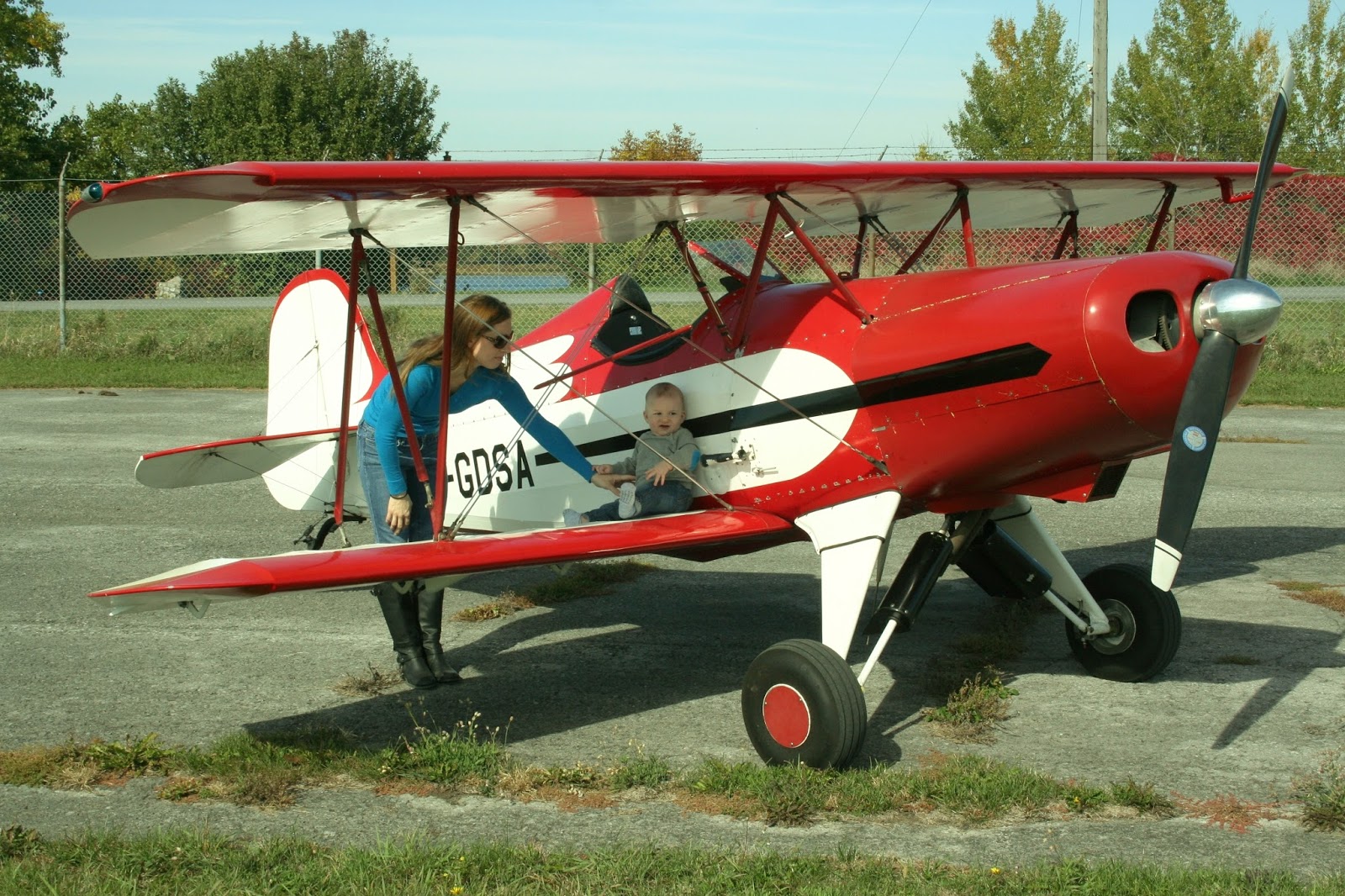
Way back in the summer of 1984, my dad posed my mom and I in front on Foxtrot Alpha Mike - me, perched on the right wing root and my mom standing by the trailing edge, reaching out with one arm. As I've mentioned before, it is my only picture with my dad's Smith.  Truly, given everything that's happened since, it's a treasure.  31 years later, we recreated that same shot with my wife and son.

My mom, me and Foxtrot Alpha Mike at Rockcliffe in June 1984.  The hangar that houses my Smith now occupies the ramp in the background. (Author's Collection)
Mel, Elgin and Delta Sierra Alpha in September 2015 at Rockcliffe. (Author's Collection)
My last flight of the 2015 season was a late afternoon hop down the Ottawa River to Rockland, dodging grey clouds, light showers and the bitter spectre of hanging up our wings for the winter.  It was uncharacteristically warm for a November day but I left the balaclava up around my mouth and nose so that I could take advantage of the warmth my breath afforded.  The colors of the trees stood out against the landscape with a vibrancy unique to late fall afternoons in these parts, even under the gloomy stillness of the sky.  I crossed the Ottawa River between Rockland and Wendover to the east and then returned home along the north shore of the river.  The land below us was swampy, presenting itself as gentle, undulated waves of browns and blacks before climbing into the grey and green mounds of the Gatineau Hills to the north.  As we glided westbound for home, I could just pick out our reflection on the face of the beautifully still and peaceful river.
Our final landing of the season, like its counterpart the year before, was beautifully executed and a perfect punctuation mark on a season that had seen nearly 51 hours.
The Smith being prepared for winter storage. (Author's Collection)
A week later, in the blackness of night with only a shop light driven by a generator to illuminate the inside of the hangar, I swapped the flying oil out for preservation oil and prepared the Smith for her winter hibernation.  Together, over two seasons, we had embarked on 91 total flights covering a little more than 73 hours...all in the pursuit of a little boy's dream and the cementing of a father's legacy.

Father and FAM on the right, 1981; Son and DSA on the left, 2015. (Author's Collection)